Train of Four
Put a number on the twitches your nerve stimulator produces.
Peripheral nerve stimulators are in every operating room; quantitative monitors are not. Train of Four turns an iPhone strapped to the patient’s palm into an acceleromyograph. The stimulator fires a train of four, the phone’s accelerometer records the thumb, and the app shows the four twitches, the peak of each one, and the ratio of the fourth to the first: T4/T1.
iPhone
Free. No account, no ads, and nothing leaves the phone unless you export it.
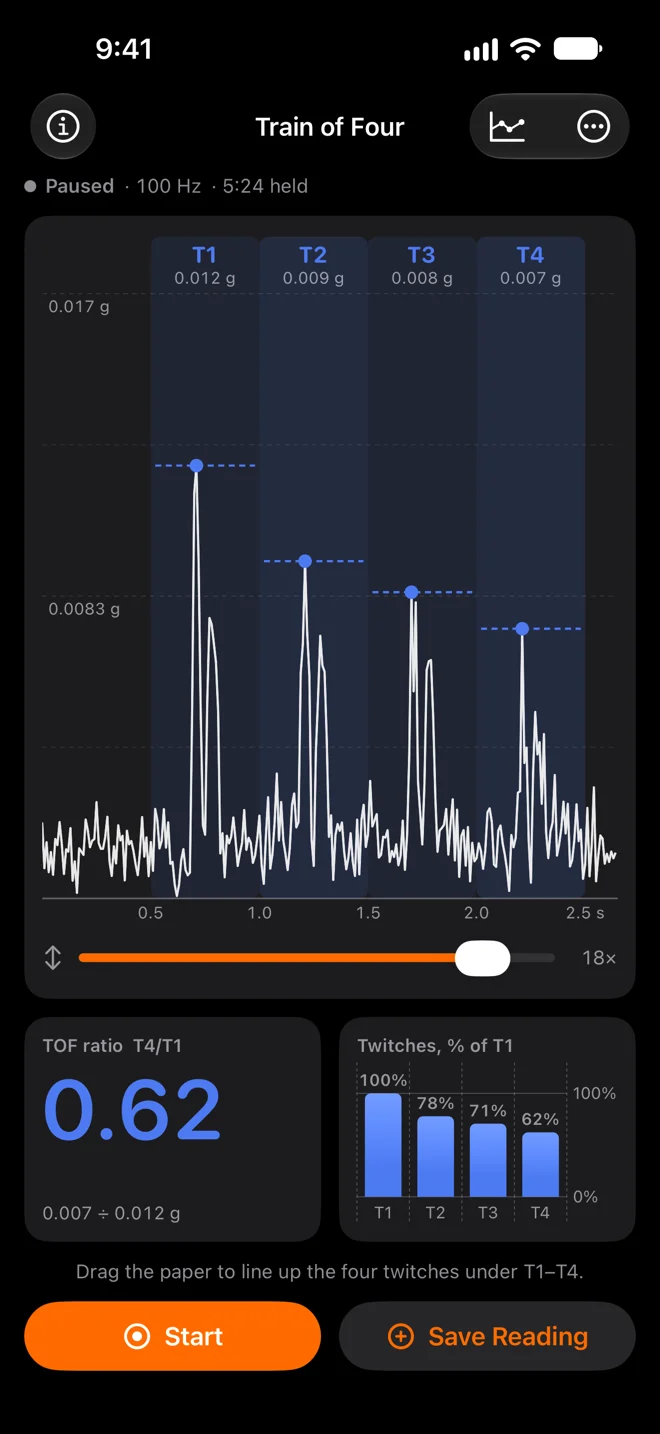
Demonstration data, not a patient.
Published in the Canadian Journal of Anesthesia
Ratan K. Banik and Michael M. Todd of the Department of Anesthesiology at the University of Minnesota, with Kiichi Takeuchi, who wrote the app, evaluated it against a commercial acceleromyograph (a Stimpod 450) in adults recovering from rocuronium. The phone was strapped to one hand and the Stimpod to the other; both were stimulated every 20 seconds until the Stimpod showed full recovery after sugammadex.
- 22 patients, 141 paired readings.
- On average the two agreed: a mean difference of −0.04 (SD 0.19) in the TOF ratio.
- When the phone read 0.9 or more, the Stimpod read below 0.9 in 30 of 68 pairs (44 %).
- When the phone read 1.1 or more, it did so in 2 of 10 pairs.
In the authors’ words, the app “should not be viewed as a replacement for validated AMG devices”, but when targeting a ratio of 1.1 or more, the chance of wrongly concluding full recovery “appears substantially reduced compared with reliance on PNS or clinical signs alone”. They see it as a practical, low-cost way to quantify the train of four where commercial monitors are not available.
Banik RK, Takeuchi K, Todd MM. A “Train of Four” iPhone application to enhance the utility of peripheral nerve stimulators. Can J Anesth 2026;73:313–315. doi:10.1007/s12630-026-03108-4
See it on a hand
The University of Minnesota team’s own videos: the app during a train of four, and the palm strap that holds the phone.
How it works
- Strap the phone to the palm, screen up, so the thumb’s movement moves it.
- Stimulate the ulnar nerve with your peripheral nerve stimulator: a train of four, four pulses half a second apart.
- Watch the paper. The trace scrolls like a chart recorder, and four columns, T1 to T4, each half a second wide, sit over it. Let a train pass under them, or pause and drag the paper back until each twitch sits in its column.
- Read T4/T1. Each column shows its peak in g; the ratio is the fourth divided by the first, to two decimals, with the two peaks it is made of right under it. The fade is drawn as four bars, the way monitors show it.
The paper keeps the last ten minutes: drag back through them while it keeps recording, and jump back to live. A slider or a pinch exaggerates the trace vertically to show small twitches; it changes the drawing, not the numbers. The status line shows how many samples a second the sensor is really delivering.
Readings across a reversal
Tap Save Reading when a train sits under the columns, and the app keeps T4/T1, the four peaks and the time. The Readings chart shows the ratio climbing as the patient recovers, with plain lines at 0.9 and 1.1, the two values the study compared, and no verdict of its own.
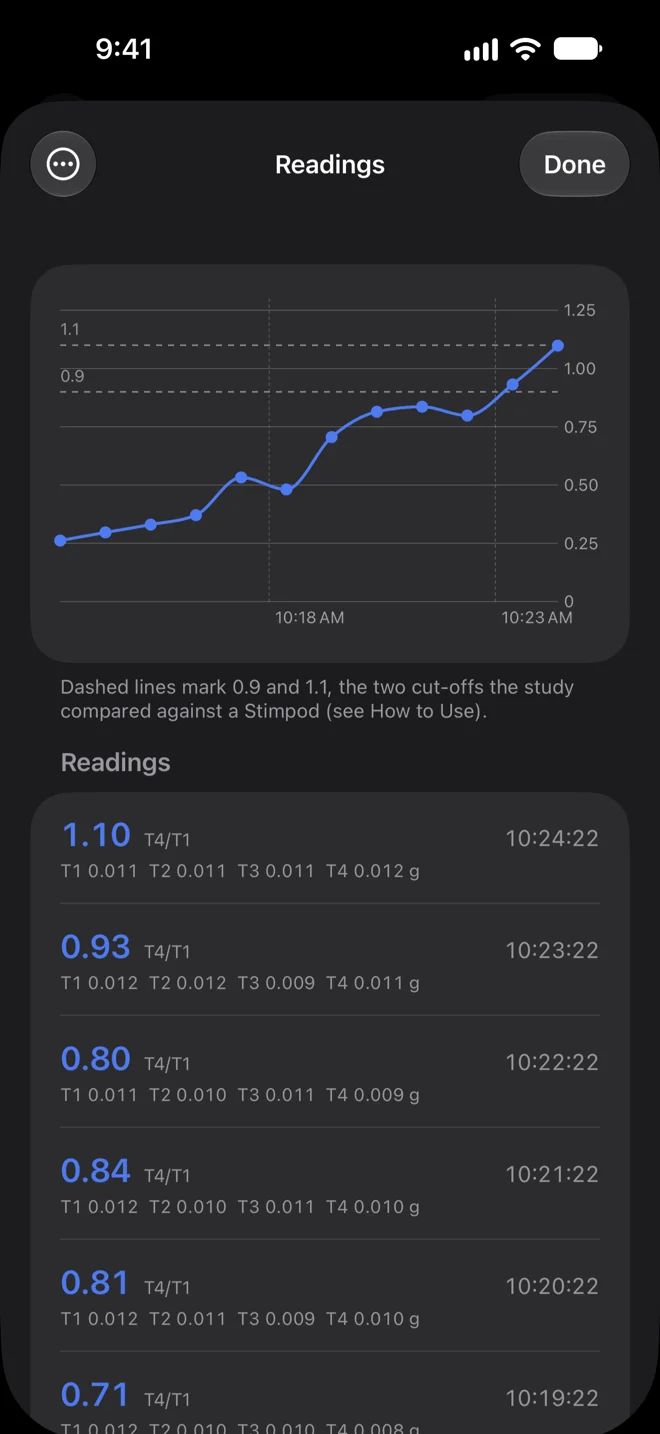
Export shares the saved readings and the raw accelerometer data, every sample of the last ten minutes, as CSV files, for your own analysis.
The method
The measurement is the one the study evaluated, and it is simple enough to state in full:
- The accelerometer is read 100 times a second on all three axes, in units of gravity.
- Gravity is filtered out of each axis: the raw value minus a running estimate that takes 10 % of each new sample. What remains is movement, not the phone’s orientation.
- The trace is the mean of the three filtered axes, without sign.
- The screen holds 2.65 seconds. Four columns of 0.5 s start half a second in; each one’s value is the largest movement inside it.
- T4/T1 is the fourth column’s peak divided by the first’s.
Who it is for
- Anesthesiologists and nurse anesthetists without a quantitative monitor, who have a nerve stimulator and a phone.
- Teaching: residents and students see what a train of four and its fade look like, as a trace rather than a count.
- Research on low-cost monitoring of neuromuscular blockade.
Your data
The motion stays on the phone. There is no account and no server; nothing leaves the phone unless you export it yourself.
Questions
Does it replace a quantitative neuromuscular monitor? No. The study’s authors say plainly that it should not be viewed as a replacement for validated acceleromyography devices. It puts a number on what a nerve stimulator shows where no monitor is available.
What ratio should I look for? The app reports the ratio; it does not judge it. In the study, a phone reading of 0.9 or more disagreed with the Stimpod (which read below 0.9) in 44 % of pairs, and a reading of 1.1 or more in 2 of 10. Read the paper for the details.
What do I need besides the app? A peripheral nerve stimulator that delivers a train of four, and a way to hold the phone in the palm; the strap in the video above is one.
Does it need the internet? No. Everything happens on the phone.
Who made it? Kiichi Takeuchi at ObjectGraph wrote it in 2015 with Dr. Ratan Banik, who brought the clinical question. ObjectGraph has made apps since the first day of the App Store in 2008.
The story of the app, from a 2014 email about iSeismometer to the paper, is in the Train of Four 2.0 post.